
Spoken Language
"If you talk to a man in a language he understands, that goes to his head. If you talk to him in his language, that goes to his heart."
- Nelson Mandela
Curriculum Rationale
Spoken language (oracy) is the foundation of all learning. It is the primary medium through which pupils formulate ideas, express thoughts, consolidate understanding, and build social relationships. In our curriculum, spoken language is explicitly taught, valued, and modelled—not left to chance.
A structured approach to spoken language ensures pupils learn to talk (developing confidence, vocabulary, and rhetorical skill) and learn through talk (using dialogue to clarify, deepen, and challenge learning across all subjects).
Intent: Why Spoken Language Matters
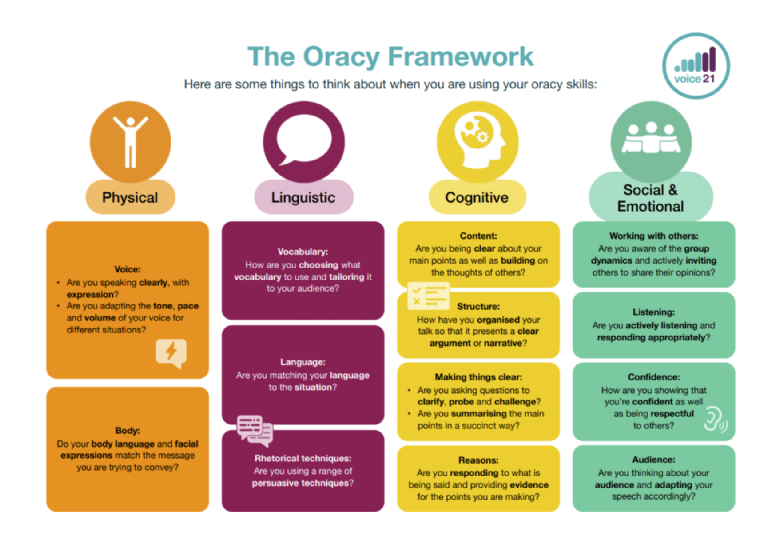
At St Patrick's, our Spoken Language curriculum bridges the gap between conversational language and formal academic discourse. It is designed around four key pillars of oracy:
-
Social & Emotional: Developing confidence, turn-taking, active listening, and empathy in collaborative settings.
-
Physical: Mastering non-verbal communication, posture, eye contact, projection, and vocal variety.
-
Linguistic: Expanding vocabulary, using precise register, and structuring grammatically accurate sentences.
-
Cognitive: Reasoning, asking probing questions, constructing arguments, and summarising complex ideas.
Key Objectives
-
Closing the Vocabulary Gap: Prioritizing Tier 2 (cross-curricular) and Tier 3 (subject-specific) vocabulary instruction to combat socio-economic language disadvantages.
-
Empowering Pupil Voice: Ensuring every child finds their voice, learns to advocate for themselves, and respects diverse perspectives.
-
Underpinning Literacy: Developing spoken expression as the direct engine for reading comprehension and written composition.
Implementation: Progression from EYFS to Key Stage 2
Spoken language is taught through explicit instruction (e.g., talk tactics, sentence stems, presentation skills) and embedded cross-curricular opportunities.
1. EYFS: Foundations of Communication & Language: Focus: Listening, Attention, and Vocabulary Development.
In the Early Years Foundation Stage, spoken language is integrated into daily interactions, continuous provision, and adult-led play:
-
Interactive Storytelling & Rhymes: High-quality texts, rhymes, and singing to build phonological awareness and rhythm.
-
Communication-Rich Environments: Adults model rich vocabulary, expand on children’s utterances, and introduce open-ended questions during play.
-
Self-Regulation & Expressive Language: Supporting children to name emotions, resolve conflict verbally, and articulate their needs clearly.
2. Key Stage 1: Structural Fluency & Discussion: Focus: Active Listening, Reasoning, and Group Talk Rules.
In Years 1 and 2, talk shifts from personal experience to structured classroom discourse:
-
Talk Rules & Sentence Stems: Introducing fundamental sentence scaffolds (e.g., "I agree with... because...", "In my opinion...").
-
Presentational Oracy: Performing poetry, retelling, and short show-and-tell sessions to build projection and eye contact.
-
Exploratory Talk: Working in pairs (think-pair-share) to reason through maths problems or science observations.
3. Lower Key Stage 2: Adaptability & Formal Discourse: Focus: Register, Debating, and Evidence-Based Talk.
In Years 3 and 4, pupils learn to tailor their language to audience and purpose:
-
Audience Awareness: Distinguishing between informal dialogue and formal presentations.
-
Constructive Critique: Learning how to respectfully challenge peers using evidence (e.g., "Building on what [Name] said, the evidence suggests...").
-
Role Play & Drama: Using conscience alleys and hot-seating to explore character motives and historical perspectives.
4. Upper Key Stage 2: Rhetoric & Sophisticated Reasoning: Focus: Critical Thinking, Debate, and Leadership.
In Years 5 and 6, spoken language becomes a tool for leadership and critical reflection:
-
Formal Debating: Constructing persuasive arguments, anticipating counter-arguments, and refuting points under time constraints.
-
Academic Presentations: Preparing multimedia speeches, adjusting pace, tone, and rhetorical techniques for maximum impact.
-
Metacognition: Reflecting on their own oracy skills and assessing peer contributions against defined criteria.
Pedagogical Strategies & Inclusion
To ensure all pupils—including those with SEND and English as an Additional Language (EAL)—access the curriculum, we utilise structured classroom talk tools:
| Strategy | Purpose & Application |
| Sentence Stems | Provides linguistic scaffolding for turn-taking, agreeing/disagreeing, and justifying opinions. |
| Talk Roles | Assigns explicit roles in small group discussions (e.g., Instigator, Builder, Challenger, Summariser). |
| Scaffolding & Visuals | Employs visual cues, word mats, and gesture prompts to support EAL and speech-and-language pupils. |
| Wait Time | Enforces extended thinking time (3–5 seconds) before accepting spoken responses to deepen cognitive processing. |
Impact: Measuring Success
The impact of our spoken language curriculum is evaluated through both process and outcome:
-
Academic Attainment: Stronger reading comprehension and writing outcomes stemming from oral rehearsal.
-
Confidence & Well-being: Pupils present ideas articulate, self-assured, and respectful of differing viewpoints.
-
Assessment: Formative assessment is embedded through classroom observation against the four oracy strands (Physical, Linguistic, Cognitive, Social & Emotional), avoiding standard written testing for spoken fluency.