
Computing
"Computers are incredibly fast, accurate, and stupid. Human beings are incredibly slow, inaccurate, and brilliant. Together they are powerful beyond imagination."
- Albert Einstein
Curriculum Intent
The primary computing curriculum equips pupils to participate in a rapidly changing world where work, leisure, and daily life are increasingly transformed by technology. Using the Purple Mash Scheme of Work (2Simple), our intent is to deliver a high-quality, ambitious computing education that balances technical knowledge, creative application, and digital safety.

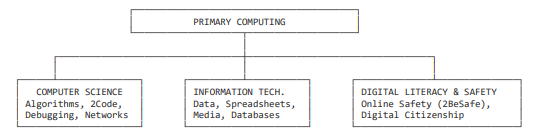
The curriculum is structured around the three core statutory strands of the English National Curriculum for Computing, alongside an embedded focus on Digital Citizenship:
Core Drivers for Selecting Purple Mash
-
Cohesive Skill Progression: A spiral curriculum model from Early Years Foundation Stage (EYFS) to Year 6 ensures prior learning is consistently revisited, consolidated, and extended.
-
Integrated Software Ecosystem: All tools (e.g., 2Code, 2Calculate, 2Investigate, 2Animate) are hosted on a single, secure cloud platform, removing the friction of managing disparate software applications.
-
Equity & Accessibility: Individual pupil logins (2Dos) enable seamless access both in the classroom and at home, supporting independent practice and remote learning.
-
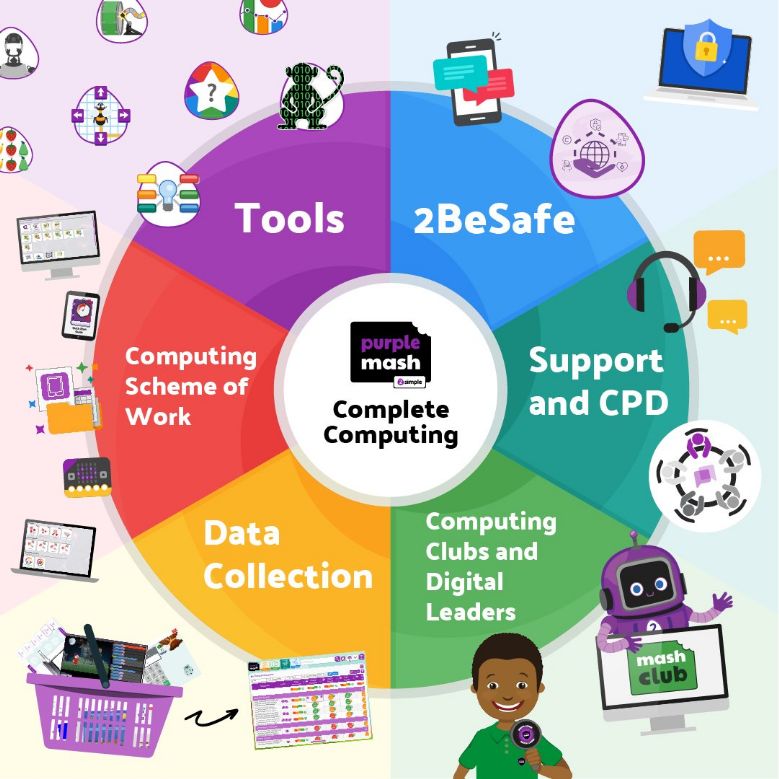
Teacher Support & CPD: Embedded teaching slideshows, knowledge organisers, and video guidance build subject knowledge and confidence across all staff members, reducing planning burden while maintaining high standards.
Implementation
Progression Across Key Stages
| Key Stage | Focus & Core Knowledge | Purple Mash Tools & Applications | Key Outcomes |
| EYFS (Mini Mash) | Early exploration of cause-and-effect, directional language, digital art, fine motor control, and basic screen navigation. | Mini Mash, 2Paint, 2Count, Interactive Whiteboard games | Pupils learn to log in, navigate simple interfaces, and understand technology as a creative tool. |
| Key Stage 1 (Y1–Y2) | Introduction to algorithms, precise instruction sequences, debugging, creating digital content, and basic online safety. | 2Code (Chimp), 2Quiz, 2Publish, 2Go, 2BeSafe | Pupils write and debug simple block programmes, create digital text/images, and know how to seek help online. |
| Lower KS2 (Y3–Y4) | Computational thinking, sequence, selection (IF statements), variables, databases, animation, and email etiquette. | 2Code (Gibbon), 2Investigate, 2Animate, 2Email | Pupils design conditional programmes, collect and analyse data, and understand digital communication protocols. |
| Upper KS2 (Y5–Y6) | Complex programming (repetition, functions, complex variables), network infrastructure, binary, spreadsheets, and critical digital literacy. | 2Code (Gorilla), 2Calculate, 23D Primary, 2BeSafe | Pupils build multi-variable games, understand how the internet functions, model data in spreadsheets, and critically evaluate online sources. |
Pedagogical Approach
-
Unplugged to Plugged Learning: Abstract concepts (e.g., algorithms or network topologies) are introduced through physical, unplugged activities before being applied within 2Code or digital tools.
-
Explicit Vocabulary Acquisition: Every unit incorporates predefined key vocabulary via Purple Mash Knowledge Organisers, ensuring pupils use technical terms (e.g., decomposition, variable, operand, iteration) with accuracy.
-
Retrieval Practice: Lessons begin with structured recall questions checking retention from previous units and year groups.
-
Embedded Online Safety: Online safety is not treated as a one-off topic; while taught discretely using the 2BeSafe units, digital citizenship principles are reinforced every time pupils log in, create, or share work.
Cross-Curricular Integration
Purple Mash facilitates links across the primary curriculum:
-
Mathematics: Data representation, coordinates, geometry, and formula modelling via 2Calculate and 2Graph.
-
Science & Humanities: Database classification of animals/materials using 2Investigate; digital storytelling and history presentations using 2Publish and 2Present.
-
Design & Technology: Control systems, 3D modelling (23D Primary), and physical computing device integration.
Impact
Assessment & Monitoring
-
Formative Assessment: Teachers monitor real-time progress during lessons as work is submitted via 2Dos. Embedded self-review questions at the end of lessons encourage pupil metacognition.
-
Summative Assessment: Progress is evaluated against unit-specific assessment statements (Emerging, Expected, Exceeding). Pupil work is automatically archived in digital portfolios inside Purple Mash, providing a cumulative body of evidence across all key stages.
-
Subject Leadership: The Purple Mash analytics dashboard allows subject coordinators to monitor coverage, verify alignment with the National Curriculum, and track cohort progress efficiently.
Pupil Outcomes
By the end of Key Stage 2, pupils leaving primary school will be:
-
Competent Computer Scientists: Able to analyse problems in computational terms and write, debug, and refine programmes to accomplish specific goals.
-
Fluent IT Creators: Capable of selecting, using, and combining software applications to express ideas, present data, and solve problems analytically.
-
Responsible Digital Citizens: Confident in navigating the online world safely, aware of their digital footprint, critical of online information, and equipped to handle digital challenges with resilience and respect.